Measure the longest, widest, and highest fixed points with attachments in their storage position. Then add the actual drop needed on all four sides.
Model dimensions rarely include every bucket, handle, mirror, chute, roll bar, hitch, or folded attachment. Field measurement avoids a cover that fits the machine body but misses the real outline.
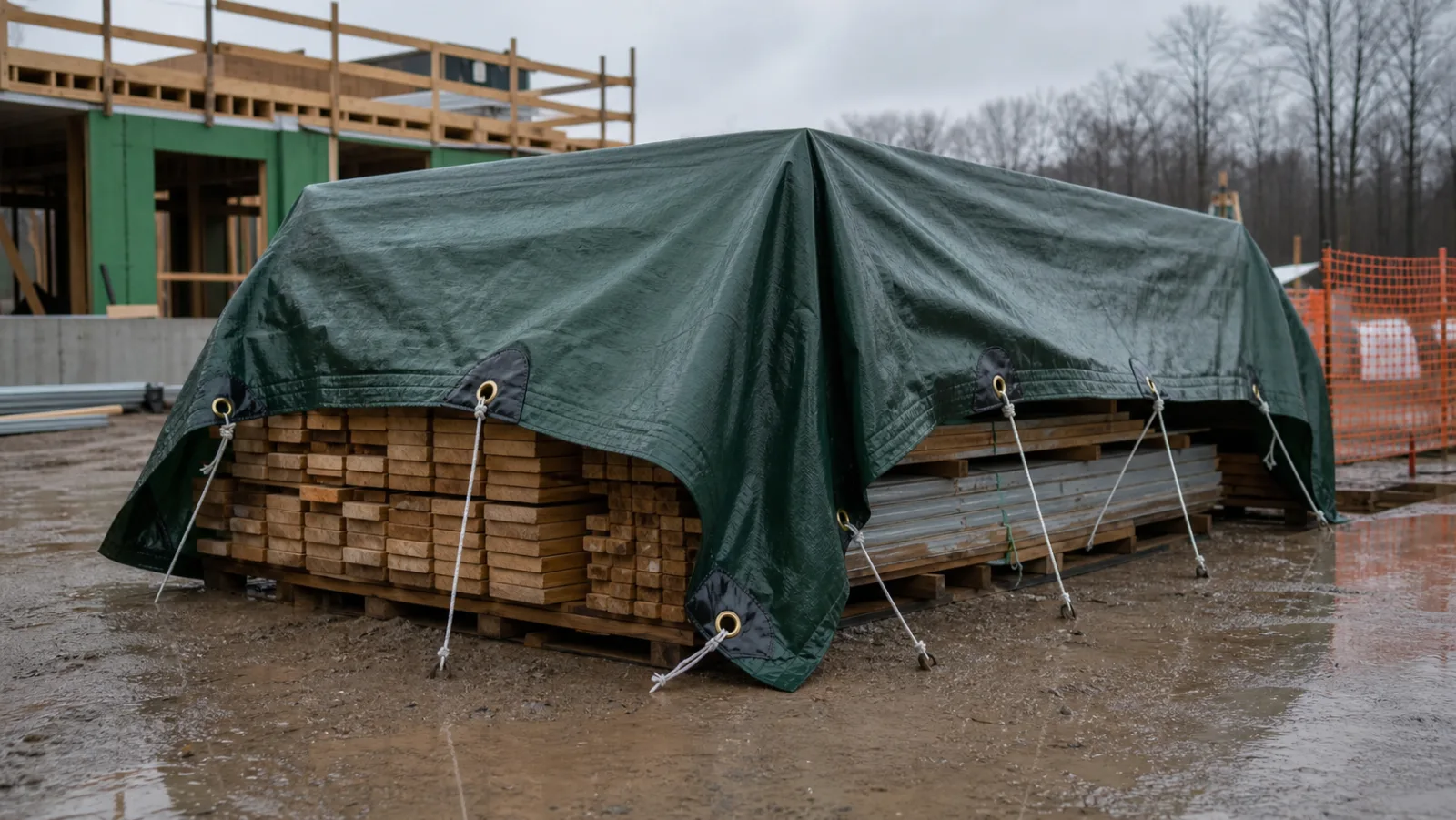
Measure the full stored profile
- Park safely, lower attachments, switch off, cool the machine, and follow its manual.
- Measure the longest point, including hitch or attachments to be covered.
- Measure the widest point, including handles, mirrors, decks, or chutes.
- Measure from the highest point to the lowest desired cover line on each side.
- Mark exhaust, sharp edges, controls, vents, and areas that must remain accessible.
Add two drops, not one
For a roughly rectangular machine, tarp length = equipment length + front drop + rear drop + working allowance. Tarp width = equipment width + left drop + right drop + working allowance. Drops can be unequal when the machine is offset or one side needs access.
Worked example
A compact tractor measures 10 ft long and 5 ft 6 in wide in storage position, with the loader parked. You want the cover to reach about 18 in down from the top outline on every side. The tarp length becomes 10 ft + 1.5 + 1.5 = 13 ft, and the width becomes 5.5 + 1.5 + 1.5 = 8 ft 6 in, plus a small working allowance. A 14 × 10 ft stock cover fits with margin. At that size, even a heavier coated fabric stays in the one-person handling range, which you can confirm with the weight calculator.
Map contact and drainage points
Use edge protection where necessary, keep the fabric off hot exhaust components, and avoid blocking designed ventilation. Build a peak or slope so rain sheds instead of forming a deep pocket.
Choose material and handling weight together
Frequent removal favors manageable weight; exposed corners and repeated outdoor use raise abrasion demands. Large PVC-coated covers may be durable candidates but hard for one person to move. A lighter PE cover may be practical for less demanding exposure. Verify the exact product.
Measurement worksheet
| Item | Your value |
|---|---|
| Longest stored profile | _____ ft _____ in |
| Widest stored profile | _____ ft _____ in |
| Front / rear drops | _____ / _____ in |
| Left / right drops | _____ / _____ in |
| Sharp, hot, or vented areas | ________________ |
Frequently asked questions
How much bigger than the equipment should the tarp be?
Add the drop you want on each of the four sides, twice per direction, plus working allowance. A cover that just reaches the machine’s outline leaves the lower body exposed and is hard to anchor. Drops that reach the ground collect water and chafe, so choose a deliberate cover line.
Should I cover attachments separately?
Usually it is simpler to include mounted attachments in the stored profile and size one cover around the whole outline. Remove or fold what you safely can first, following the machine manual. Separate small covers work for attachments that stick far beyond the main body.
What size tarp do I need for a riding mower?
Measure the stored profile with the deck and any chute, then add drops. A typical residential riding mower often lands near an 8 × 10 ft cover for full side coverage, but compute from your own machine, especially with a bagger or plow attached.
Is a heavy PVC tarp worth it for equipment storage?
It depends on exposure and handling. Repeated outdoor exposure and abrasion favor heavier coated fabrics, but a large heavy cover is hard for one person to remove daily. For frequently used machines, a lighter cover that actually gets used beats a heavy one left on the ground.
How do I stop the tarp from chafing on sharp edges?
Pad or cap sharp points before covering, use edge protectors where the fabric bears on corners, and tension the cover so it cannot saw back and forth in wind. Chafe, not weather, is what usually kills equipment covers first.
How this guide was prepared
We separate geometry and unit conversions from product claims, use exact standards where available, and flag specifications that vary by manufacturer. See our editorial policy for the review process.