PE tarps are usually lighter and easier to handle for general covers. PVC-coated polyester tarps are commonly heavier, more abrasion resistant, and better suited to repeated industrial or truck use. The best choice depends on the finished construction, not only the polymer name.
“PVC tarp” and “PE tarp” describe broad product families. They do not guarantee a particular strength, life, waterproof rating, or temperature range. A fair comparison uses the actual fabric mass, base reinforcement, coating, seams, hems, hardware, and intended service.
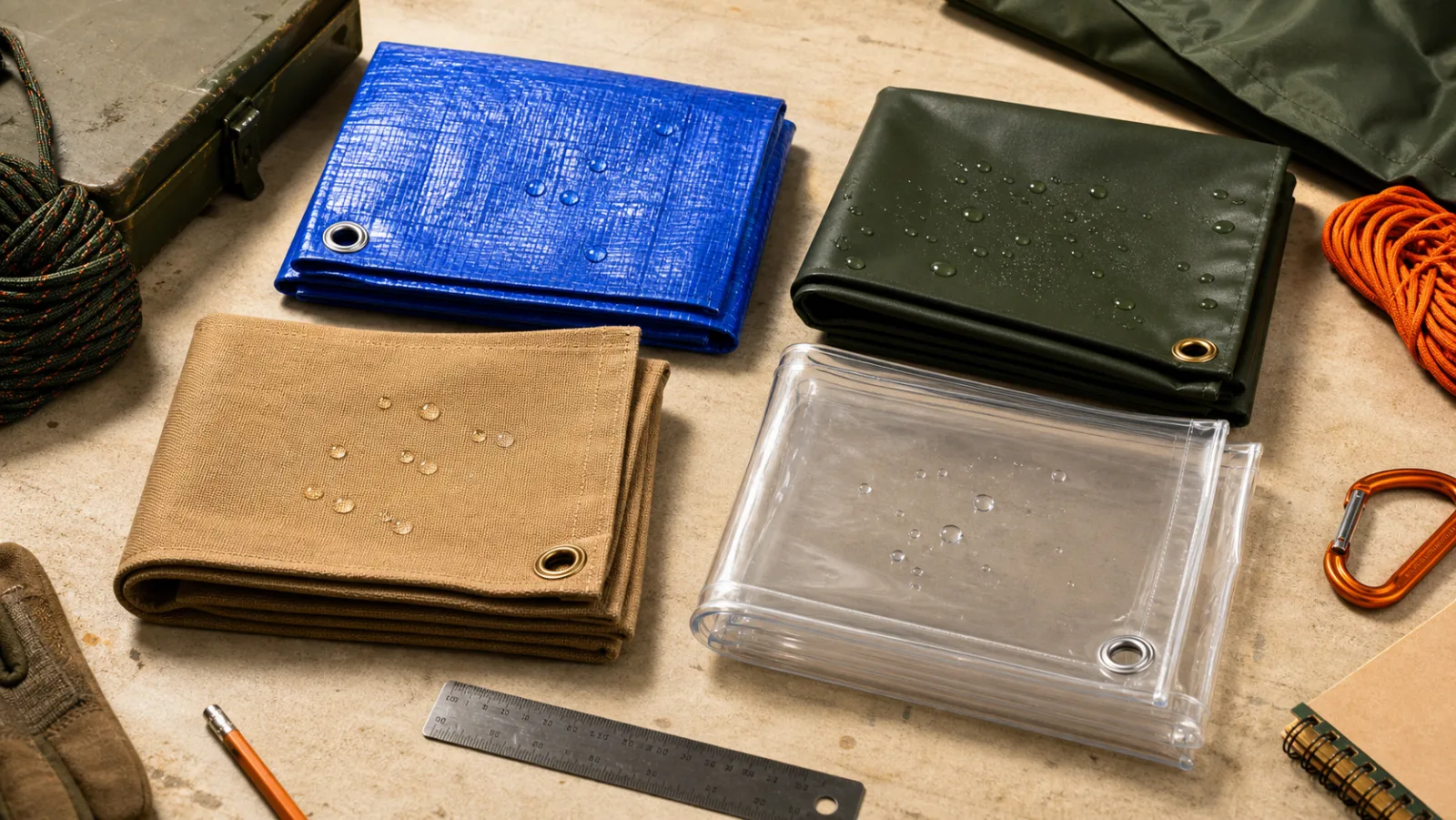
How the constructions usually differ
A common PE tarp is woven polyethylene tape with polyethylene coating or lamination on both sides. The weave provides reinforcement while the outer layers provide water shedding and color. These tarps can be very light or fairly substantial, but the familiar hardware-store versions emphasize low weight and cost.
A common PVC tarp uses a polyester woven base coated with polyvinyl chloride. The coating can create a smooth, flexible, abrasion-resistant surface. Many truck and industrial fabrics fall in roughly the 14–22 oz/yd² range, though lighter and heavier constructions exist.
| Decision factor | Typical PE tarp | Typical PVC-coated tarp |
|---|---|---|
| Handling weight | Lighter | Heavier |
| Initial cost | Usually lower | Usually higher |
| Repeated abrasion | Varies; light products wear quickly | Often better in industrial grades |
| Folding and carrying | Easier at large sizes | Can require more people or equipment |
| Repair | Tape and patches vary in longevity | Compatible vinyl repair methods may be available |
| Common roles | General covers, temporary weather protection | Truck, industrial, repeated-use covers |

Water, sun, abrasion, and temperature
Water
Both families can shed water when the surface and seams are intact. “Waterproof” on a listing should not be treated as a promise that pooled water, worn creases, stitched seams, or damaged grommets will never leak. Pitch the cover so water can leave and avoid deep unsupported pockets.
Sun
Outdoor life depends on stabilization, pigment, coating, exposure angle, climate, and mechanical stress. Material name alone does not provide a useful service-life number. Ask for a defined UV claim or warranty conditions rather than relying on color or thickness.
Abrasion
Heavy PVC-coated fabrics often tolerate sliding and repeated handling better than light PE covers, but sharp edges can damage either. Use corner protectors and eliminate flapping. A heavy fabric dragging over an edge under wind load can fail quickly.
Cold and heat
Flexibility and cracking behavior are formulation-specific. A generic “PVC” or “PE” label is not enough for severe cold, hot equipment, or fire exposure. Request the manufacturer’s rated temperature range and keep tarps away from exhausts, heaters, and ignition sources.
Total weight changes the decision
Material mass multiplies by area. At the same 20 × 30 ft size, a 140 GSM cover has a base-material estimate near 17 lb, while a 610 GSM fabric is near 75 lb before hems and hardware. The heavier tarp may be tougher, but it also takes more effort to lift, pull, fold, dry, and store.
For one-person temporary use, manageable weight can be a safety and quality advantage. For a tarp that is rolled mechanically over a truck body every day, a heavier purpose-built fabric and compatible system may make more sense.
Which should you choose?
PE is often a better starting point when…
The cover is temporary or occasional, weight and price matter, abrasion is limited, and replacement is acceptable.
PVC-coated fabric is often a better starting point when…
The tarp will be handled repeatedly, dragged or tensioned in a controlled system, repaired during service, or specified for truck and industrial work.
These are starting points, not rules. A premium reinforced PE product may outperform a light PVC product for a specific test, and an unsuitable heavy vinyl tarp can be worse than a light cover if nobody can deploy it correctly.
Questions to ask before buying
- Is the stated GSM or oz/yd² for the finished coated fabric?
- What is the base reinforcement and construction?
- What are the finished dimensions and tolerance?
- How are seams, hems, corners, and grommets reinforced?
- Is there a documented temperature or UV claim?
- What repair method is compatible with the coating?
- What will the finished tarp weigh at your required size?
Frequently asked questions
Which lasts longer outdoors, PVC or PE tarpaulin?
PVC-coated polyester generally tolerates long outdoor exposure, abrasion, and repeated handling better than woven polyethylene. PE covers are usually chosen for shorter-term or lighter-duty use. Actual life depends on UV stabilization, coating quality, and how the tarp is tensioned and stored.
Which material is lighter to handle?
PE tarps are much lighter for the same coverage area, which is why they dominate casual home use. A large PVC-coated tarp can weigh several times more than an equivalent PE sheet, so plan handling and the number of people needed before choosing a size.
Is a PE tarp actually waterproof?
A coated woven PE tarp sheds water when new and intact, but the coating is thin and can pinhole or wear at fold and abrasion points. PVC-coated fabrics carry a thicker, more continuous coating and are the safer choice where reliable waterproofing matters over years of use.
Why is PVC tarpaulin more expensive?
The polyester base fabric and the thicker coating both cost more to produce, and the finished fabric is heavier to ship. The price gap narrows when you compare cost per season of service rather than cost per purchase.
Can both materials be repaired?
Yes, but with different methods. PE repairs usually use adhesive patch tapes designed for polyethylene. PVC-coated fabric repairs use PVC patches with solvent or heat-weldable adhesives. Match the patch chemistry to the coating, and clean and dry the area before applying anything.
How this guide was prepared
We separate geometry and unit conversions from product claims, use exact standards where available, and flag specifications that vary by manufacturer. See our editorial policy for the review process.