EPA guidance says to store wood outdoors, off the ground, with only the top covered because covering the sides traps moisture.
The goal is a small rain-shedding roof over a stable stack, not an airtight wrap.
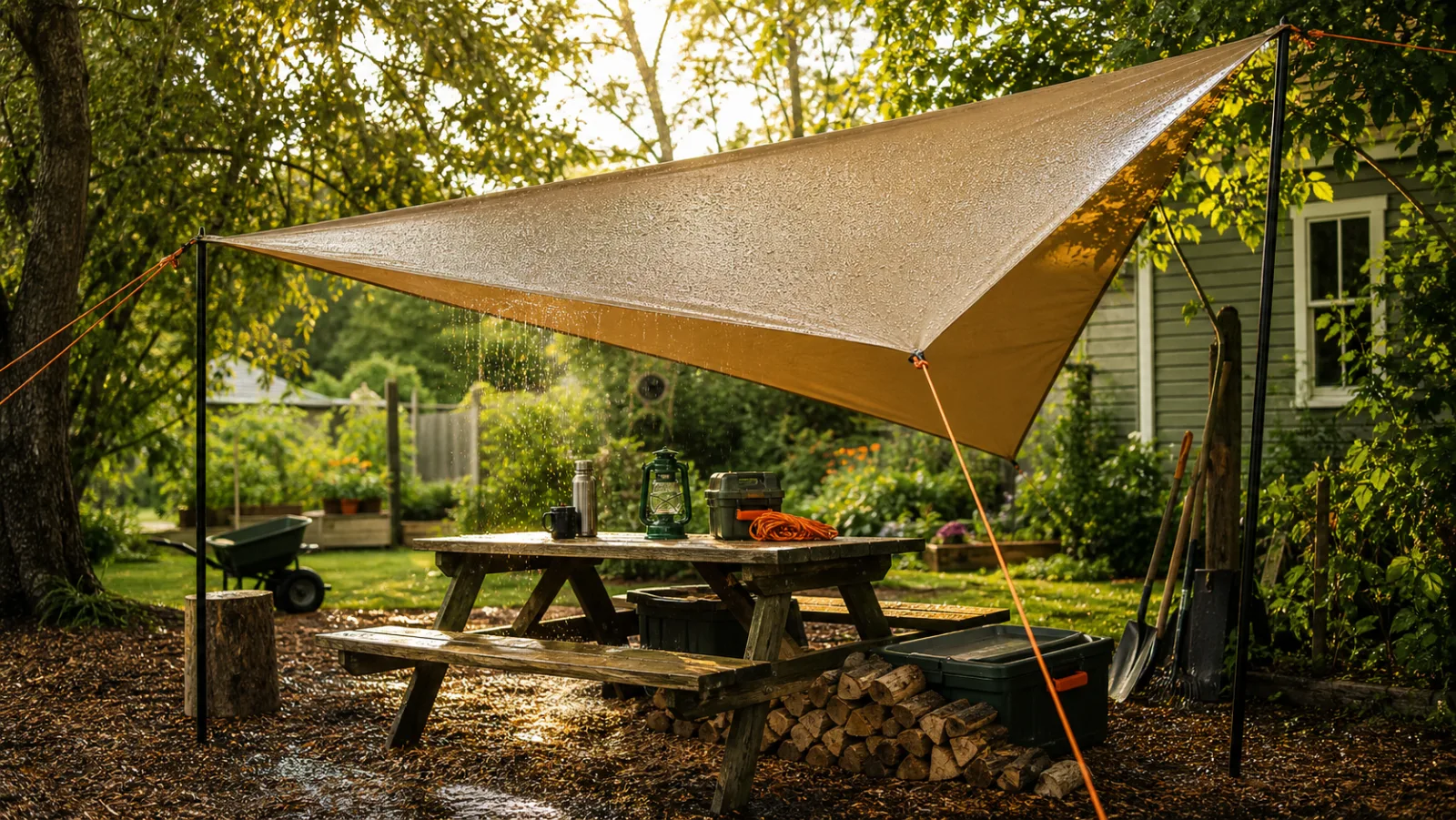
Measure the top footprint
- Measure stack length and top width.
- Add modest overhang at both ends and both sides to move water clear of the wood.
- Allow for a raised center, ridge board, or support that creates drainage slope.
- Choose attachment points that do not pull the stack over or create trip hazards.
For a simple top sheet, minimum length = stack length + two end overhangs. Minimum width = the sloped top path + two side overhangs. Avoid full height drops.
Worked example
Say your stack measures 8 ft long with a 4 ft deep top, and you want about 1 ft of overhang on every side to carry drips past the wood. The minimum sheet is roughly 10 ft long and 6 ft wide measured along the slope. If you add a ridge support that raises the center about 8 in, the sloped path grows slightly, so rounding up to a 10 × 8 ft stock cover gives working room without draping the sides. Compare that with wrapping the same stack to the ground: you would need a much larger sheet, it would trap moisture against the wood, and it would catch far more wind.
Keep the sides open
Place the stack off the ground on a stable base and leave gaps for airflow. Do not let a tarp sag against the sides or collect water. A loose full wrap can trap moisture and flap against the wood.
Wind needs a plan
Use a small cover, smooth slope, and suitable attachments. Heavy objects placed loosely on top can fall; ropes and loose corners can create hazards.
Choose material for the real job
A lightweight PE tarp is a common top-cover starting point because it is easy to reposition. Canvas may breathe but its rain resistance and treatment vary. Mesh does not provide a solid rain barrier. Whatever the family, inspect holes, seams, and tie points.
Seasonal checks
- Drain standing water and correct sagging.
- Keep the bottom of the stack dry and ventilated.
- Repair sharp protrusions and loose corners.
- Check moisture before burning; EPA says wood burns best below 20% moisture content.
Source: US EPA Best Wood-Burning Practices. EPA notes the Burn Wise material is now a historical record.
Frequently asked questions
Should I cover the whole firewood stack with a tarp?
No. EPA guidance recommends covering only the top of the stack. Wrapping the sides traps moisture against the wood, slows drying, and can raise moisture content instead of lowering it. Keep the sides open so air can move through the stack.
How much overhang should a firewood tarp have?
Enough to move dripping water clear of the wood on all sides, typically a modest allowance rather than a full drop to the ground. Large overhangs flap in wind, collect water, and pull on attachment points without improving protection.
What size tarp do I need for a standard rack of firewood?
Measure the stack top, then add end and side overhangs. A stack roughly 8 ft long and 4 ft deep often works well with a cover around 10 × 6 ft once overhangs and a drainage slope are included. Compute from your own stack rather than buying by the rack name.
Is a breathable canvas tarp better than plastic for firewood?
For a top-only cover, what matters most is shedding rain while the sides stay open. A lightweight PE top sheet is common because it sheds water reliably and is easy to reposition. Canvas breathes but its rain resistance depends on treatment; either way, never wrap the stack.
How do I keep the tarp from sagging into the stack?
Create a raised center with a ridge board, spare log, or support so the cover forms a slope, and tension it at planned attachment points. A flat sheet over an uneven pile collects water pockets that add weight and drip through.
How this guide was prepared
We separate geometry and unit conversions from product claims, use exact standards where available, and flag specifications that vary by manufacturer. See our editorial policy for the review process.