Tarp width = load width + left drop + right drop. Tarp length = covered load length + front overlap + rear overlap. Measure the loaded profile, not the empty deck.
Flatbed tarp names such as “lumber tarp” and “steel tarp” describe common configurations, but the needed dimensions come from the actual freight and the way multiple tarps overlap. A familiar stock size is useful only after the load dimensions are known.
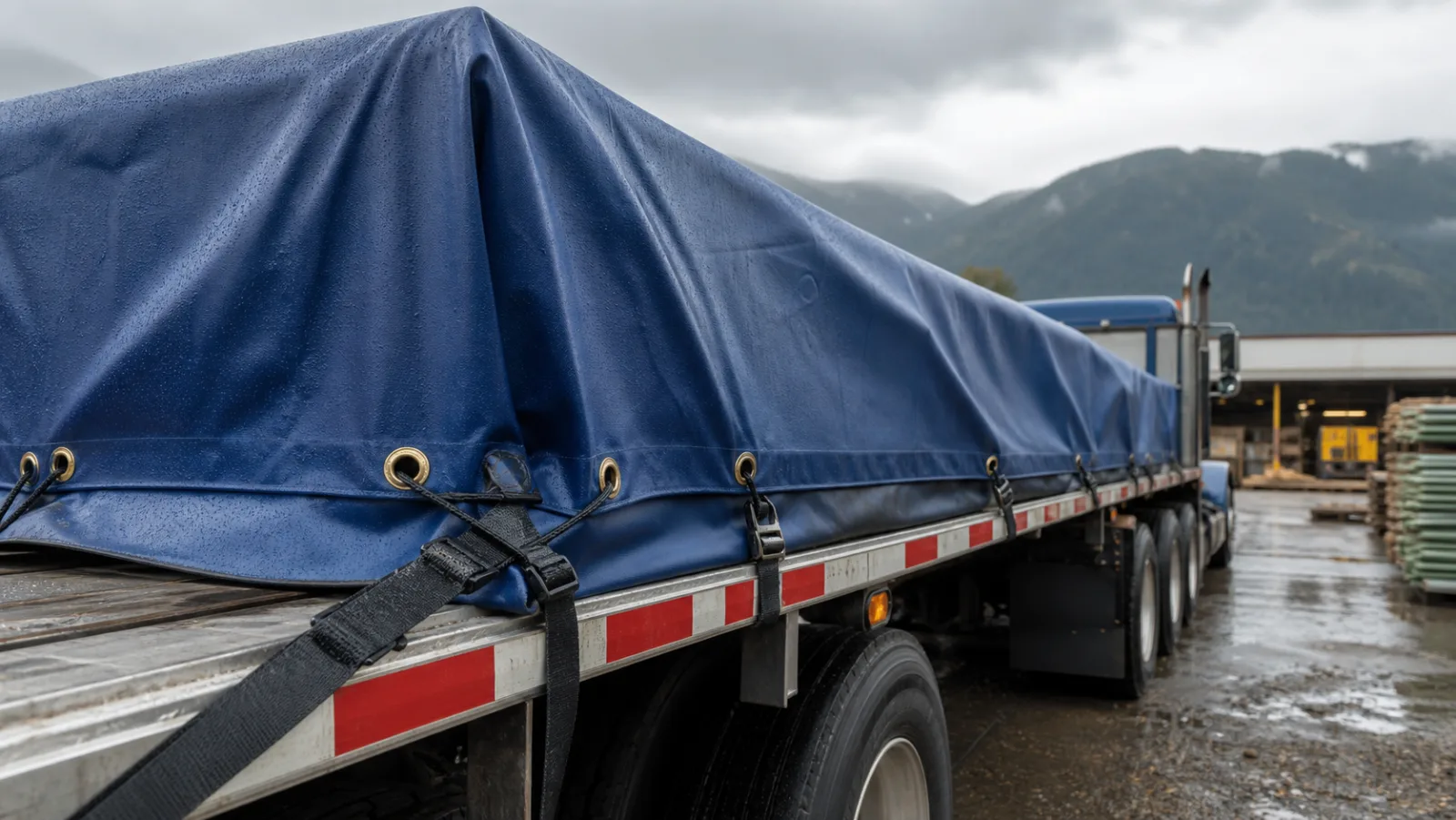
Measure the loaded profile
- Measure the freight from front to rear at the longest point requiring coverage.
- Measure the widest point, including packaging, dunnage, and irregular edges.
- Measure the required drop from the top on both sides. Drops may be unequal.
- Measure any front or rear face that must be fully covered.
- Identify sharp corners, lifting points, and tiedown paths before the tarp is unfolded.
For a rectangular 8 ft wide load requiring an 8 ft drop on each side, the cross-load fabric requirement is 24 ft. That is why common full-drop lumber tarps can be much wider than the trailer deck.
Do not use trailer dimensions alone
A 48 ft trailer does not mean the covered load is 48 ft long, and an 8 ft 6 in deck does not describe a high load’s required tarp width. Use the loaded envelope.
Lumber tarps and steel tarps
Lumber tarps are the wider, taller configuration: they carry long side drops—often 6 to 8 ft—for full-height freight, and usually include an end flap that closes the front face against road spray. Steel tarps are shorter, with drops around 3 to 4 ft, built for low, dense loads like coils, plate, and pipe. The names describe the traditional cargo, but the decision is really about drop geometry: the tarp width must equal load width plus both side drops, and the drops must reach below the rub rail with fabric left to secure.
Common US stock configurations are steel tarps around 16 × 20 ft or 16 × 27 ft, and lumber tarps around 20 × 27 ft or 24 × 27 ft, often carried as a matched pair with a mid-deck overlap. A 16 ft wide steel tarp on an 8 ft 6 in load leaves under 4 ft per side—fine for a 3 ft coil, far too short for a full-height palletized load. A 24 × 27 ft lumber tarp in 18 oz coated fabric can weigh around 90 lb before hardware, so confirm the handling weight before choosing the largest option.
For the full comparison of stock sizes, drop requirements, and handling trade-offs, see Lumber Tarp vs Steel Tarp: Sizes, Drops & How to Choose.
| Configuration | Typical reason to choose it | Measurement that controls fit |
|---|---|---|
| Full-drop lumber tarp | Tall rectangular freight | Top width plus both long drops |
| Short-drop steel tarp | Lower-profile coils, plate, or compact loads | Top width plus shorter drops |
| Three-piece or multiple-tarp set | Long loads and manageable sections | Individual coverage plus overlap |
| Fitted machinery tarp | Repeated coverage of a known shape | Actual profile and attachment pattern |
Names and dimensions vary by supplier. Confirm finished size, flap geometry, rows of D-rings, and whether drops are measured from the center or edge.
Worked examples
8 ft wide load with 6 ft drops
Required width is 8 + 6 + 6 = 20 ft before any extra side allowance. If the covered length is 24 ft and you need 2 ft at each end, minimum length is 28 ft. A nominal 20 × 30 ft configuration may fit geometrically if its finished dimensions meet the requirement.
8 ft wide load with 8 ft drops
Required width is 24 ft. A 20 ft wide steel tarp cannot be made to fit by rotating it if the load length also exceeds 20 ft. The geometry must work in both dimensions.
Unequal drop
If the load is offset or one side needs 7 ft while the other needs 5 ft, add the actual drops: 8 + 7 + 5 = 20 ft. Centering marks can help position an unequal-drop plan correctly.
When multiple tarps make more sense
One very large tarp may reduce seams but become difficult and unsafe to lift, climb with, unfold, or control in wind. Multiple tarps can divide the weight and fit different load sections. They also create overlap zones that must face away from expected airflow and be secured to prevent wind from entering.
Plan the overlap before loading. The required amount depends on shape, direction of travel, tarp construction, and securement method; a universal few-inch number is not appropriate for every highway load.
Cargo securement and worker safety
A tarp protects or contains; it does not by itself make cargo secure. Use rated tiedowns, edge protection, blocking, bracing, and other equipment required for the load. Commercial motor vehicles in the United States are subject to cargo-securement requirements in 49 CFR Part 393, Subpart I.
- Use fall-prevention methods and avoid climbing on freight where possible.
- Do not attempt to spread a large tarp in strong wind.
- Use edge protectors where the fabric or tiedowns cross sharp corners.
- Keep tarp material and loose straps out of wheels, lights, and moving components.
- Inspect D-rings, webbing, seams, and repair areas before travel.
Frequently asked questions
What is a "drop" on a flatbed tarp?
The drop is the vertical distance the tarp hangs down the side of the load from the top surface. Size the tarp so the drop covers the load side plus enough deck to tie down below the rub rail, and remember the drop is needed on both sides, so it counts twice in the width calculation.
What is the difference between a lumber tarp and a steel tarp?
Lumber tarps are longer and taller, sized for full-height loads, and usually include an end flap. Steel tarps are shorter and built for lower, denser loads. The names describe the traditional cargo, but what matters is whether the dimensions match your load profile.
What tarp sizes are common on a 48 ft flatbed?
Common stock sizes include steel tarps around 16 × 27 ft and lumber tarps around 24 × 27 ft, often used in pairs with an overlap to cover a full-length load. Treat these as orientation sizes and compute your requirement from the actual load length, width, and drop.
Should I buy one large tarp or two smaller ones?
Two smaller tarps are easier to lift, fold, and position, especially in wind, and a damaged section is cheaper to replace. The trade-off is managing the overlap seam so it sheds water. For frequent full-length loads, many operators prefer a matched pair over one very large sheet.
Does a flatbed tarp secure the load?
No. The tarp and its bungees or ties only keep the fabric in place. The load itself must be restrained with rated securement devices under applicable cargo-securement rules, and the tarp must never be asked to do that job.
How this guide was prepared
We separate geometry and unit conversions from product claims, use exact standards where available, and flag specifications that vary by manufacturer. See our editorial policy for the review process.