Write down the required finished size, handling cycle, abrasion points, temperature, sun exposure, water path, attachment method, and acceptable total weight. Then compare products against that list.
PVC-coated tarpaulin is a broad category. The coating, polyester base, fabric mass, surface finish, seams, hems, webbing, hardware, and fabrication method can all change performance. “Heavy duty” is not a specification.
Read the fabric specification
Finished mass
Look for GSM or ounces per square yard and confirm it applies to the finished coated fabric. Common truck and industrial products may be described around 14, 18, or 22 oz/yd², but the correct value depends on the task. Higher mass increases total tarp weight quickly.
Base fabric
The woven polyester base carries much of the tensile load. A listing that gives only coating material and total ounces leaves out useful construction detail. Ask for base-fabric or scrim information and relevant test values if failure has real consequences.
Coating and finish
Coating formulation affects flexibility, abrasion, cleaning, welding or repair compatibility, and weathering. A lacquered surface may clean differently from an untreated finish. Flame-retardant, food-contact, antistatic, or low-temperature claims require specific documentation for the intended application.
A number needs a test method
Tensile, tear, adhesion, cold-crack, and flame results are meaningful only with a test method, specimen direction, units, and acceptance criteria. Avoid comparing isolated numbers from unlike tests.
Inspect the finished construction
- Finished dimensions: confirm tolerance and whether the listed size is cut or finished.
- Seams: identify welded, stitched, or combined construction and how it affects water and repair.
- Hems: look for rope, webbing, or additional layers where tension is applied.
- Corners: corners should match the intended pull direction and abrasion.
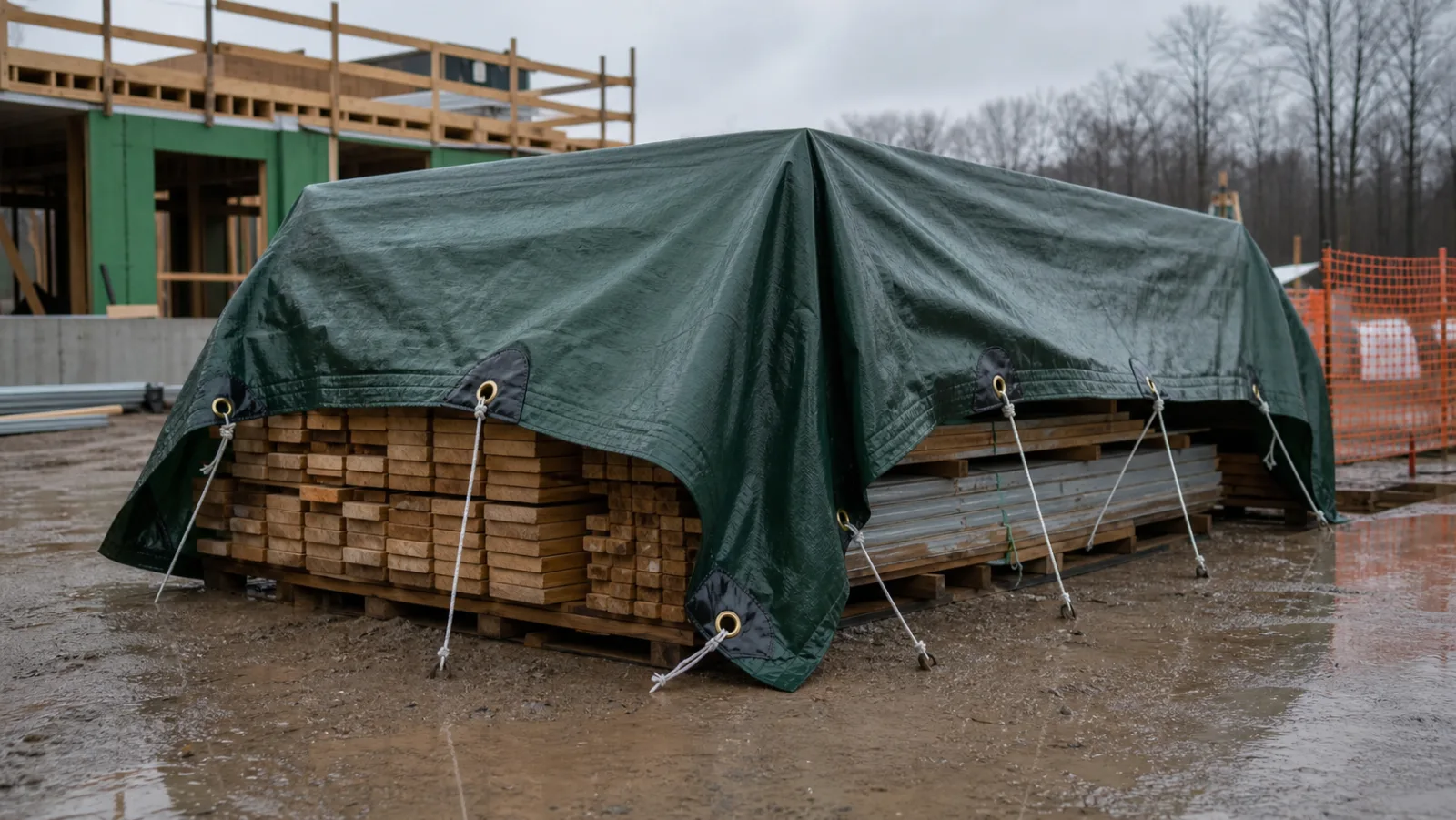
- Grommets and D-rings: spacing is less important than reinforcement and load distribution.
- Attachment compatibility: a tarp used in a roller system must match that system’s hardware and operating loads.
A strong fabric with weak, poorly positioned hardware can fail early. Likewise, a dense row of grommets does not make each attachment point safe to overload.

Match the environment
Abrasion
Map every place the tarp touches steel, masonry, wood corners, straps, or the ground. Use edge protection and design out flapping. Abrasion resistance is not a reason to drag the tarp unnecessarily.
Sun and weather
Ask for the basis of UV and weathering claims. Service life changes with climate, color, orientation, tension, pollution, folding, and maintenance. Avoid an exact lifespan promise that has no defined exposure conditions.
Temperature
Request the manufacturer’s cold-flex or operating-temperature information for winter trucking, freezers, hot climates, or equipment covers. Keep PVC tarps away from hot exhaust, open flame, welding, and surfaces beyond the rated range.
Water
Plan slope and drainage. Even waterproof fabric performs poorly when unsupported pockets collect water, seams are damaged, or the tarp is used as a structural membrane.
Calculate total handling weight
Size can matter more than the difference between two fabric grades. An 18 oz/yd² fabric is about 610 GSM. At 20 × 30 ft, the base material estimate is around 75 lb before hems and hardware. At 30 × 50 ft it is around 188 lb.
Decide how the tarp will be lifted, deployed, dried, folded, and stored. Mechanical systems, multiple smaller sections, or more workers may be necessary. A tarp that is too heavy to position correctly can deliver worse real-world coverage than a lighter appropriate product.
PVC tarpaulin buying checklist
| Ask for | Why |
|---|---|
| Finished size and tolerance | Confirms actual coverage |
| Finished GSM or oz/yd² | Supports weight comparison |
| Base fabric and coating description | Explains construction |
| Relevant test methods and values | Makes performance claims comparable |
| Seam, hem, corner, and hardware detail | Shows where loads are carried |
| Temperature and weathering documentation | Matches the environment |
| Repair and cleaning instructions | Supports service life |
| Warranty terms and exclusions | Defines the supplier’s actual commitment |
Finally, inspect a sample if the purchase is important. Check flexibility, odor requirements, surface finish, reinforcement, seam quality, and compatibility with your attachment system.
Frequently asked questions
What fabric weight should I choose for PVC tarpaulin?
Match the mass to the handling cycle rather than chasing the heaviest option. Light covers and occasional use can work well at lower weights, while daily-handled industrial and truck covers commonly use fabrics in the 450 to 700+ GSM range. Confirm the figure applies to the finished coated fabric.
What is the difference between laminated and knife-coated PVC fabric?
Laminated fabric bonds PVC film layers onto a scrim; knife coating spreads liquid PVC directly onto the woven base, which generally gives stronger coating adhesion and better long-term flex life. For demanding or long-term outdoor use, coated constructions are usually the safer specification.
How long does PVC tarpaulin last outdoors?
Service life depends on UV stabilization, coating thickness, tension, chafe points, and climate. A well-specified coated fabric can serve for years outdoors, while an unstabilized or lightly laminated fabric can degrade much sooner. Ask for the UV treatment and any weathering test data rather than relying on a warranty headline.
What should I check about grommets and hems?
Look for reinforced hems, welded or double-stitched seams, and grommets set through reinforced patches at sensible spacing for the load. Corner reinforcement matters most, because corners carry the highest stress when the tarp is tensioned.
Is the thickest PVC tarp the safest choice?
No. Excess weight makes a tarp harder to deploy, tension, and store, which can cause more damage than it prevents. Choose the lightest construction that meets the abrasion, wind, and exposure demands of the job, and put the savings into better hardware and reinforcement.
How this guide was prepared
We separate geometry and unit conversions from product claims, use exact standards where available, and flag specifications that vary by manufacturer. See our editorial policy for the review process.