PVC tarpaulin is a coated fabric: a woven polyester (or similar) base with a polyvinyl chloride coating on one or both faces. The base carries tensile load. The coating is the weather face. Seams, hems, and hardware make the tarp.
“PVC tarp” names that construction family. It does not name a weight, a strength, a temperature range, or a quality grade.
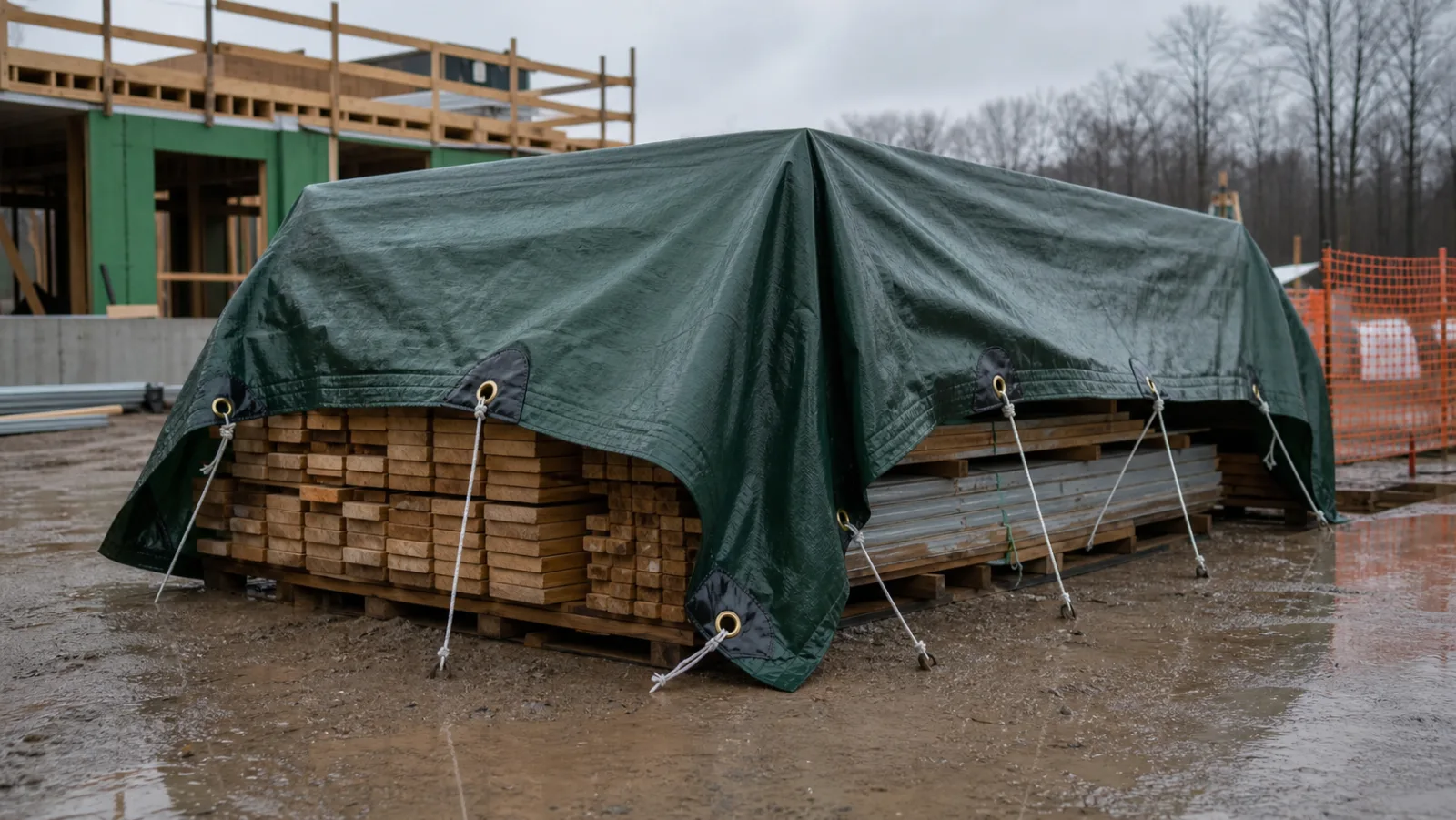
How PVC tarpaulin is built
Start from the inside. A woven polyester scrim takes the pull. Yarn denier and thread count describe that scrim; they are not the same as the finished ounces. PVC is then applied as a coating (knife or paste coating, where liquid PVC is spread onto the cloth) or as a lamination (film bonded to the scrim). Coating generally gives stronger adhesion and better flex life; lamination is common on lighter products. A lacquer or top coat may be added for dirt release, UV, or print.
ISO 2286-2 treats three masses as the basic description of a coated fabric: total mass per unit area, mass of the coating, and mass of the substrate. The substrate mass after coating is not always the same as the uncoated cloth, because bonding agents and dimensional change during processing stay in the number.

Finished sheets add welded or stitched seams, rope or webbing in the hem, corner patches, and metal hardware. Those parts fail as often as the fabric body. For how to choose among complete products, use the PVC buying checklist. For PE versus PVC as families, use PVC vs PE rather than repeating that comparison here.
How to read a spec sheet
A useful sheet names the method next to the number. A number without a method is a marketing line.
| Number on the sheet | What it measures | Method you may see | What it does not tell you |
|---|---|---|---|
| GSM or oz/yd² | Mass per area of the finished coated fabric | ISO 2286-2 (total, coating, and substrate mass) | Thickness, life, or waterproofing |
| Thickness | How thick the coated fabric is | ISO 2286-3 | Strength; two fabrics at the same thickness can differ in scrim |
| Tensile / elongation | Force and stretch to break a strip | ISO 1421 | How a grommet or a hem will fail |
| Tear | Force to continue a tear | ISO 4674 or related methods | Puncture on a sharp corner |
| Coating adhesion | How well the PVC stays on the scrim | Product-specific peel methods | UV life |
| “18 oz” | Usually 18 oz/yd² ≈ 610 GSM | Mass conversion, not a thickness test | Mil; do not convert ounces to mil |
| “Heavy duty” | A sales phrase | None | Anything measurable |
Ounces are mass, not thickness
Confirm that “18 oz” is ounces per square yard of finished coated fabric. Convert it to GSM if you need to compare listings (GSM guide). Keep it off the mil chart. The unit converter does the arithmetic; it does not invent a thickness.
If cold, sun, flame, chemicals, or repeated flexing matter, require product-specific data for those conditions. A flame claim without a test method is not a classification.
Where PVC tarps are considered
Repeated equipment covers, truck and trailer systems, industrial curtains, temporary partitions, and outdoor sheets that rub. Suitability still depends on the specific fabric and the way it is made up. A generic sheet is not automatically compatible with a powered roller, a rated curtain, a roof job, or a cargo-securement plan. Check total handling weight at the size you need; the weight calculator turns GSM and area into a lift estimate.
What the name does not mean
- A fixed lifespan or a universal “heavy-duty” grade
- Safe use at every temperature
- Flame resistance without a named test and classification
- Waterproof performance at seams, openings, or ponds
- Safe anchoring, wind loading, or cargo securement
If you are still deciding between PE and PVC as families, stop here and open PVC vs PE. If you already want coated polyester, take the spec table above to the buying checklist and the material selector.
Coated-fabric mass: ISO 2286-2, Rubber- or plastics-coated fabrics — Determination of roll characteristics — Part 2 (total mass, coating mass, and substrate mass). Thickness is ISO 2286-3. GSM ↔ oz/yd² conversion on this site follows NIST unit conversion; 18 oz/yd² ≈ 610 GSM is a mass conversion, not a thickness.
Frequently asked questions
Is PVC tarpaulin waterproof?
The coating is a continuous water barrier, and welded seams can be as watertight as the fabric. Real-world waterproofing still fails at stitched seams, grommet holes, worn coating, and low spots where water pools. Judge the finished product and the installation.
What does the ounce rating mean on a PVC tarp?
It usually means ounces per square yard of the finished coated fabric, a mass-per-area figure. 18 oz/yd² is about 610 GSM. It is not the weight of the whole tarp and cannot be converted into thickness in mil. ISO 2286-2 is the method that separates total mass, coating mass, and substrate mass.
How is PVC tarpaulin different from a regular poly tarp?
A regular poly tarp is woven polyethylene tape with a thin laminated surface. PVC tarpaulin coats a woven polyester base with PVC. Construction, mass, and handling differ; the full comparison lives on the PVC vs PE page. This page is about reading a coated-fabric spec.
Can PVC tarpaulin be used in cold weather?
Flexibility in cold depends on the coating formulation. Some fabrics stiffen or crack at low temperatures. Ask for that product’s cold-crack or low-temperature data rather than assuming all PVC behaves the same.
How do I repair a PVC tarp?
Clean and dry the damaged area, then apply a PVC patch with the adhesive or welding method the fabric manufacturer specifies. Patch chemistry must match the coating. Generic tapes often peel from PVC outdoors.
How this guide was prepared
We separate geometry and unit conversions from product claims, use exact standards where available, and flag specifications that vary by manufacturer. See our editorial policy for the review process.