Tension a tarp from its reinforced points—corners first, in diagonal pairs—using connectors suited to the load. Most tarp failures come from flapping and pooling, not from weak fabric, so the real goal is a cover that cannot move.
A tarp is only as good as its tie-down plan. The same sheet can last one storm or five seasons depending on how it is anchored, tensioned, and sloped.
Start at the anchor points
Every tie-down force enters the tarp through an anchor point. Factory grommets set into reinforced hems are the standard; D-rings and webbing loops handle higher loads; tarp clips grip fabric anywhere without piercing it. Tying to raw, unreinforced fabric is the fastest way to tear a cover: the point load rips through the weave long before the material itself fails.
If your tarp's grommet spacing does not match your anchor points, move the anchors or add clips—do not bridge a long gap with an over-tensioned line.
Connectors compared
| Connector | Best for | Strengths | Watch out for |
|---|---|---|---|
| Bungee balls | Quick light covers, canopy legs | Fast, forgiving in gusts | UV degradation, weak hold |
| Bungee cords | Small covers, light loads | Absorbs shock, cheap | Loses tension, snaps back dangerously |
| Poly rope (paracord, braided) | General outdoor tie-downs | Strong, UV-stable options, adjustable with knots | Needs knot skill; stretches when wet (nylon) |
| Ratchet straps | Trailers, vehicles, heavy covers | High, controllable tension | Easy to over-tighten and tear grommets |
| Tarp clips | Adding a tie point anywhere | No holes, repositionable | Grip depends on fabric thickness |
Match the connector to the consequence of failure. A garden cover that slips is an annoyance; a trailer cover that comes loose at highway speed is a hazard to everyone behind you.
Tension in the right sequence
Attach loosely at every planned point first, then tension in diagonal pairs: one corner, the opposite corner, then the remaining two. This centers the cover and prevents the creeping offset that leaves one side short. Add mid-edge points after the corners if the edge still scallops in wind.
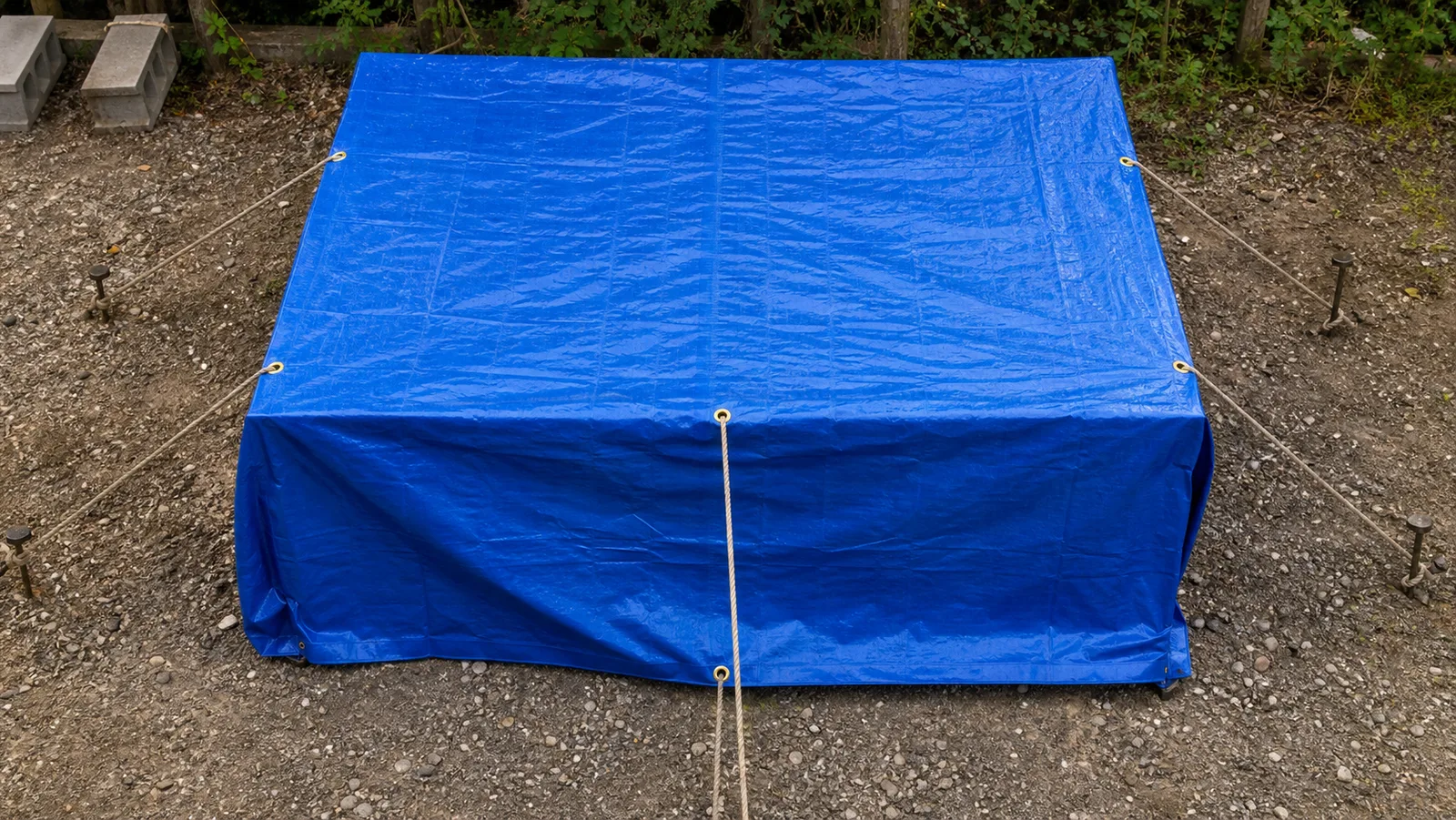
Wind is the real enemy
Flapping is what kills tarps. Each snap of loose fabric is a small impact load on grommets, seams, and coating, repeated thousands of times. The defenses:
- Slope the cover so wind and water travel over it instead of catching underneath.
- Eliminate loose sections with intermediate tie points or clips.
- Close the windward edge where air would otherwise enter and inflate the cover like a parachute.
- Pad sharp edges so tension does not saw the fabric against a corner.
Pool water is a wind problem too
A sagging pocket collects rain, the weight deepens the sag, and the cover collapses or tears. Slope every cover so water runs off an edge you choose.
Vehicles and trailers
At highway speed, airflow is relentless. Keep the cover taut with no loose hem that can lift, route straps so they cannot chafe through, and stop to recheck tension after the first few miles—loads settle and fabric stretches. Never cover lights, plates, or reflective markers, and remember that a tarp is weather protection, not cargo securement.
Common mistakes
- Tying to unreinforced fabric instead of grommets, clips, or webbing.
- Cranking ratchet straps until grommets deform.
- Leaving a windward edge open so air gets underneath.
- Trusting aged, sun-brittled bungees on a cover that matters.
- Letting one grommet carry a load meant for four.
Frequently asked questions
Are bungee cords strong enough to hold a tarp?
For light covers in mild conditions, yes. Bungees forgive gusts by stretching, which protects grommets, but they degrade in sun and lose tension over time. For large covers, vehicles, or anything people drive past, use rope or rated straps and treat bungees as a convenience, not a safety system.
Can I tie a rope directly through a grommet hole?
Yes, that is what grommets are for, but pull in line with the fabric rather than prying sideways, and do not hang heavy loads from a single grommet. Force should spread into the reinforced hem, not concentrate on one metal ring.
What if my tarp has no grommet where I need one?
Use a tarp clip (a clamp that grips the fabric without piercing it) or install a brass grommet kit through a reinforced area. Clips are faster; grommets are more permanent. Never just poke a hole and tie through raw fabric—it will tear out quickly.
How tight should a tarp be tied?
Taut enough that it cannot flap, drum, or pool water, but not so tight that the fabric or grommets carry a constant heavy preload. Wind adds large dynamic loads on top of whatever tension you start with.
Why does my tarp keep tearing at the grommets?
Usually because the cover flaps in wind, hammering the grommets thousands of times, or because the tie-downs are too tight with no give. Fix the flap first: add intermediate tie points, improve the slope, and consider connectors with a little elasticity.
How this guide was prepared
We separate geometry and unit conversions from product claims, use exact standards where available, and flag specifications that vary by manufacturer. See our editorial policy for the review process.